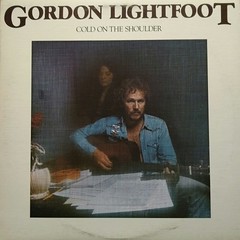
Rainy Day People is the big hit from this, Gordon's 11th record. It's a song that makes me think of my dad. I remember him playing this record from time to time. I have no idea what happened to his old records.
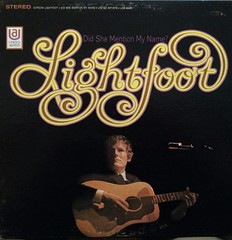
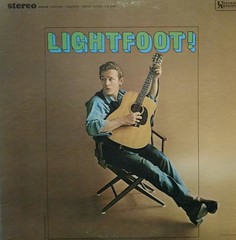
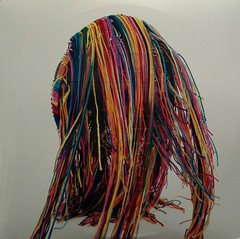
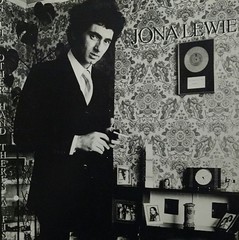
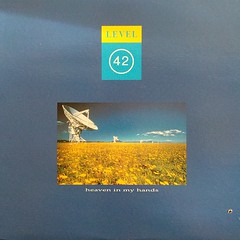
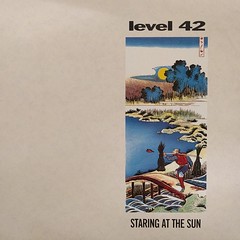
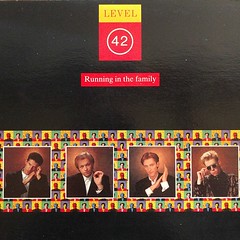
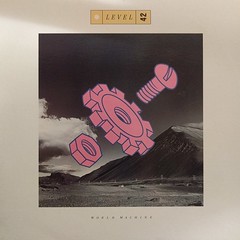
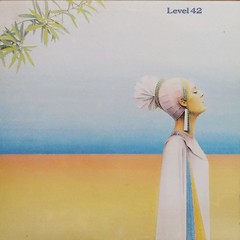
"By Running in the Family, Level 42 had almost completely thinned out their early jazz-funk and soul roots in favor of a radio-friendly keyboard pop with a light R&B vibe. The sound lies somewhere between Kool and the Gang and early Tears for Fears. But if early fans might have felt betrayed by the new direction, the band's newfound aptitude for attention-grabbing hooks and airtight instrumental polish attracted more than enough new fans to replace them." [source]Yes, I agree. Lessons in Love and the title track were big hits, if I remember correctly. I don't mind those songs, but it's a step down from World Machine.
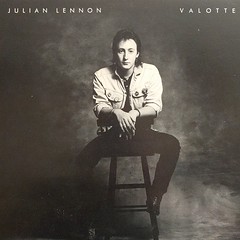
In a contemporary review for Saturday Review magazine, music critic John Swenson gave Valotte two out of five stars and critiqued that Lennon's voice lacks the "tortured cynicism and urgency that characterised his father's and, consequently, Valotte sounds like languid outtakes from Imagine." In a three-star review, Davitt Sigerson of Rolling Stone said that it is both "exciting and irritating". He found the album's similarities to John Lennon's later work strange, observing "a middle-aged sensibility, reinforced by Phil Ramone's elegant but often stodgy production, applied to unashamedly youthful themes." Robert Christgau, writing for The Village Voice, gave Valotte a "C" and panned it as "bland professional pop of little distinction and less necessity—tuneful at times, tastefully produced of course, and with no discernible reason for being". Christgau found Lennon's vocal resemblance to his father "eerie" and viewed him as "more Frank Sinatra Jr. than (even) Hank Williams Jr."I suppose each of these reviewers is right in their own way, but I looked past the album's weaknesses, mostly because I thought I was hearing the ghost of John Lennon. I haven't given this one a spin -- I'm guessing -- since the mid-1980s. I have never heard any subsequent music from Julian. These are the only songs I know.
In a retrospective review, Allmusic editor Stephen Thomas Erlewine gave Valotte three-and-a-half out of five stars and wrote that it is "by any measure the debut of a gifted pop melodicist." He viewed that on the album's highlights, Lennon exhibited a strong sense for "Beatlesque pop songwriting, drawing equally from [John] Lennon and [Paul] McCartney", and at his worst, he drew too often on contemporary conventions such as synthesisers. Paul Evans, writing in The Rolling Stone Album Guide (2004), gave the album two out of five stars and remarked that Lennon "settles for clean but modest stuff—high-end MOR," while finding all of his albums "pervaded with a sort of listlessness, a free-floating pathos." [source]
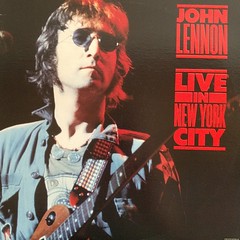
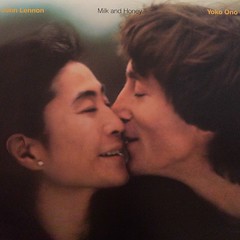
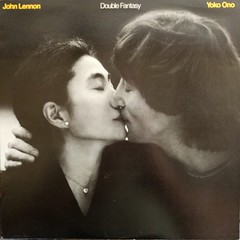
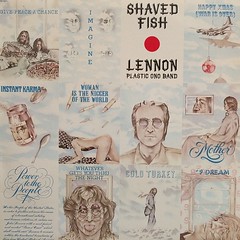
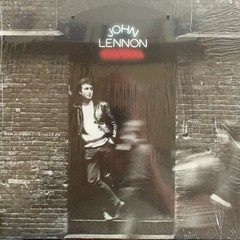
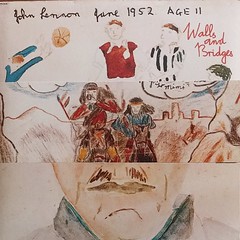
"Walls and Bridges was recorded during John Lennon's infamous "lost weekend," as he exiled himself in California during a separation from Yoko Ono. Lennon's personal life was scattered, so it isn't surprising that Walls and Bridges is a mess itself, containing equal amounts of brilliance and nonsense." [source]That makes a certain degree of sense. Lennon teams up with Sir Elton on Whatever Gets You Thru The Night. While this might not be Lennon's best record, I really love it.
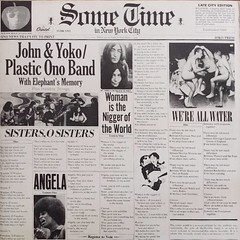
The phrase "woman is the nigger of the world" was coined by Yoko Ono in an interview with Nova magazine in 1969 and was quoted on the magazine's cover. Literary analysts note that the phrase owes much to Zora Neale Hurston's novel, Their Eyes Were Watching God, in which the protagonist Janie Crawford says, "De nigger woman is de mule uh de world so fur as Ah can see." The song describes women's subservience to men and misogyny across all cultures.Anyway, when the song comes on, it's difficult to know if I -- as a white person -- can sing along. I suppose that goes for a ton of rap tunes too. It also applies to Oliver's Army, that snappy Elvis Costello tune, when he sings:
In a 1972 interview on The Dick Cavett Show, John Lennon stated that Irish revolutionary James Connolly was an inspiration for the song. Lennon cited Connolly's statement "the female worker is the slave of the slave" in explaining the pro-feminist inspiration behind the song. [source]
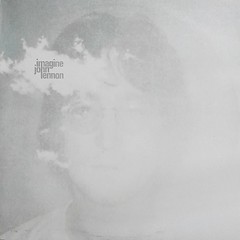
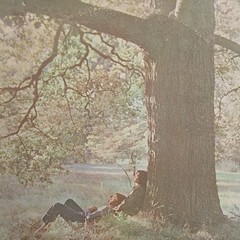
"Inspired by his primal scream therapy with Dr. Arthur Janov, Lennon created a harrowing set of unflinchingly personal songs, laying out all of his fears and angers for everyone to hear. It was a revolutionary record -- never before had a record been so explicitly introspective, and very few records made absolutely no concession to the audience's expectations, daring the listeners to meet all the artist's demands ... It's an unflinching document of bare-bones despair and pain, but for all its nihilism, it is ultimately life-affirming; it is unique not only in Lennon's catalog, but in all of popular music. Few albums are ever as harrowing, difficult, and rewarding as John Lennon/Plastic Ono Band." [source]I have a copy of the first US pressing.
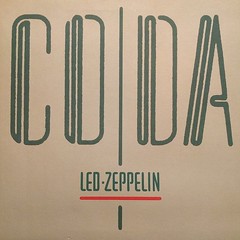
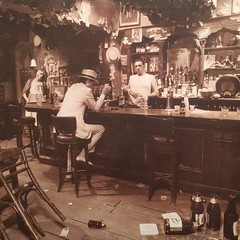
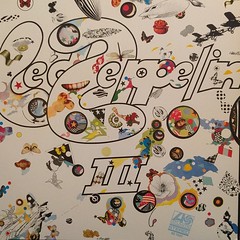
"The original album featured an unusual gimmick: the album had an outer sleeve which was made to look like a plain brown paper bag (reminiscent of similarly packaged bootleg album sleeves with the title rubber-stamped on it), and the inner sleeve featured black and white line artwork which, if washed with water, would become permanently fully coloured. There were also six different sleeves featuring a different pair of photos (one on each side), and the external brown paper sleeve meant that it was impossible for record buyers to tell which sleeve they were getting (there is actually a code on the spine of the album jacket which indicated which sleeve it was—this could sometimes be seen while the record was still sealed). The pictures all depicted the same scene in a bar (in which a man burns a Dear John letter), and each photo was taken from the separate point of view of someone who appeared in the other photos. The walls are covered with thousands of yellowed business cards and dollar bills. The photo session in a London studio was meant to look like a re-creation of the Old Absinthe House, in New Orleans, Louisiana.I have a 'C' album cover, by the way. Everything Zeppelin did was awesome, but this is a little less awesome that what cam before it.
The album artwork was designed by Hipgnosis. Storm Thorgerson recalls the design in his book Eye of the Storm:
The sepia quality was meant to evoke a non-specific past and to allow the brushstroke across the middle to be better rendered in colour and so make a contrast. This self same brushstroke was like the swish of a wiper across a wet windscreen, like a lick of fresh paint across a faded surface, a new look to an old scene, which was what Led Zeppelin told us about their album. A lick of fresh paint, as per Led Zeppelin, and the music on this album... It somehow grew in proportion and became six viewpoints of the same man in the bar, seen by the six other characters. Six different versions of the same image and six different covers.And:
Did you ever notice you could affect the dust jacket by putting water on it? If you applied spittle to it or a bit of water, it would change colour, like a children's colouring book we based it on. But we didn't tell anybody. I don't think Zeppelin told anybody, either.In 1980, Hipgnosis were nominated for a Grammy Award in the category of Best Album Package for In Through the Out Door." [source]

Upon its initial release in 1976, the album received some mixed reviews, with a number of critics considering it to be over-produced and lumbering. Indeed, the band's members themselves have since expressed a lack of fondness for the recording. Page has admitted that the end product was not the best representation of Led Zeppelin as a live band.In contrast, the 2007 reissued version received generally much more positive reviews. In a review published in Mojo magazine in December 2007 James McNair gave the album four out of five stars... [source]
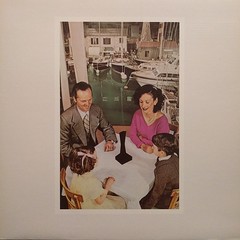
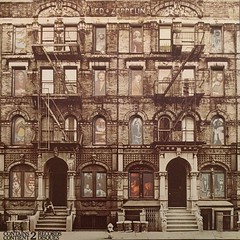
"Physical Graffiti was the first album to go platinum on advance orders alone. Shortly after its release, all previous Led Zeppelin albums simultaneously re-entered the top-200 album chart.Oddly, this record contains a tune called Houses of the Holy, which does not appear on the eponymous record.
"In March 1975, Billboard magazine's reviewer wrote: "[Physical Graffiti] is a tour de force through a number of musical styles, from straight rock to blues to folky acoustic to orchestral sounds." Similarly, Jim Miller stated in Rolling Stone that the double album was "the band's Tommy, Beggar's Banquet and Sgt. Pepper rolled into one: Physical Graffiti is Led Zeppelin's bid for artistic respectability." Village Voice critic Robert Christgau was less impressed, writing that except for side two, the material often wanders into "wide tracks, misconceived opi, and so forth", and "after a while Robert Plant begins to grate". Reviewing the album for BBC Music in 2007, Chris Jones described it as "a towering monument to the glory of Zeppelin in their high-flying heyday".
"In 1998 Q readers voted Physical Graffiti the 28th-greatest album of all time; in 2000 Q placed it at number 32 in its list of the 100 Greatest British Albums Ever; and in 2001 the same magazine named it as one of the 50 Heaviest Albums of All Time. In 2003, the TV network VH1 named it the 71st-greatest album ever. In 2003, the album was ranked number 70 on Rolling Stone magazine's list of "The 500 Greatest Albums of All Time". The album is also listed in Robert Dimery and Stevie Chick's 1001 Albums You Must Hear Before You Die (2005)." [source]
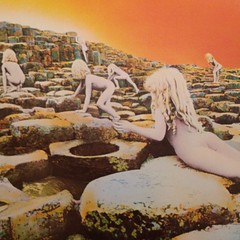
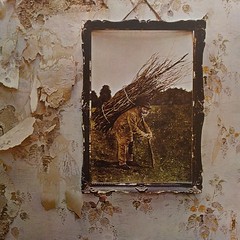
Like Led Zeppelin's fourth album, neither the band's name nor the album title was printed on the sleeve. However, manager Peter Grant did allow Atlantic Records to add a wrap-around paper title band to US and UK copies of the sleeve that had to be broken or slid off to access the record. This hid the children's buttocks from general display, but still the album was either banned or unavailable in some parts of the Southern United States for several years. [source]I think many would argue that the first four records are the band's best, but I would say that this one is at least equal. It's fabulous.
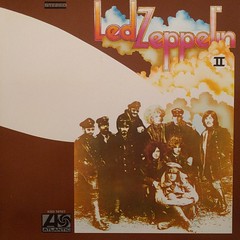
Critical reaction to Led Zeppelin II was not positive originally. John Mendelsohn wrote a negative review of the record for Rolling Stone, in which he mocked the group's heavy sound and white blues, while writing that "until you've listened to the album eight hundred times, as I have, it seems as if it's just one especially heavy song extended over the space of two whole sides". Robert Christgau jokingly referred to the band as "the best of the wah-wah mannerist groups, so dirty they drool on demand", while complaining that "all the songs sound alike". He nonetheless conceded that "Led Zeppelin simply out-heavied everyone" in 1969, "pitting Jimmy Page's repeated low-register fuzz riffs against the untiring freak intensity of Robert Plant's vocal. This trademark has only emerged clearly on the second album, and more and more I am coming to understand it as an artistic triumph." [source]I have a Canadian pressing (not the original) that I think came out sometime after 1978. The jacket of my copy looks mint, and the record is in fabulous shape too. I think there are more than 20 Canadian pressings of this LP, plus numerous 8-track, cassette, and CD issues.
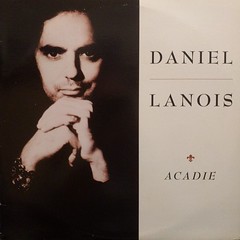
This stunning debut album by an artist that had hitherto been known only as a producer is priceless, and stands up well to repeated listening. It is a blend of New Orleans rhythm, rock, new age mysticism, and folk. It is not mushy but it is as caressing to the ear as to the mind. It has the very distinctive ethereal sound of the albums he produced for among others the Neville Brothers and Robbie Robertson. All the songs were written or co-written by Lanois, with the exception of the traditional "Amazing Grace" (done in an untraditional manner and sung by Aaron Neville). The songs affect a rural and uncomplicated yet very complete and full sound that brings the listener into their mood, swing into the full lilting joy of "Under a Stormy Sky," to the haunting and ominous "Where the Hawkwind Kills." His sound is a distinctive signature, that holds well with each different song and with each artist for whom he has fashioned albums. [source]Acadie is another record on my long list of top ten records.In addition to the LP, I own the CD Goldtop Edition, which contains six bonus tracks.