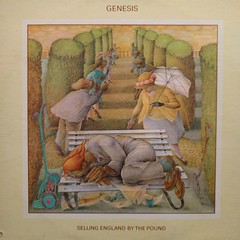
Selling England by the Pound is, without question, my favourite Genesis record. Perhaps it was the album I knew first? I'm really not sure if I can remember what Genesis records I first heard. It was all so long ago. Anyway, this album really spoke to me, and it has remained a favourite.
Once again, Phil Collins takes over on lead vocals on one song. This time, it's More Fool Me.
I am not really sure that we should concern ourselves about reviews, but it is worth noting that some reviewers didn't get this record either. What else is new?
So, here is what is probably my favourite Genesis song, though I readily admit I have no idea what it means.:
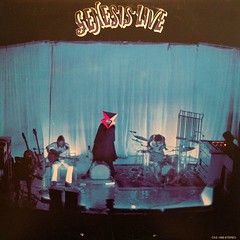
Oddly, Live could well be the best thing Genesis released to this point. If you don't believe me, read the review from Allmusic, which is overflowing with love for the record. The LP contains only five tracks: Watcher of the Skies, Get 'Em Out by Friday, The Return of the Giant Hogweed, Musical Box, and The Knife.
That's all you need to know. Here is the entire record:
This is either the third or fourth Genesis record, depending on whether or not you count From Genesis to Revelation as a real record, and some don't. The record continues to demonstrate the maturation of the band's musical vision. The centrepiece is the sprawling Supper's Ready, which takes almost the whole of side two.
"Certainly, they've rarely sounded as fantastical or odd as they do on the epic 22-minute closer "Supper's Ready," a nearly side-long suite that remains one of the group's signature moments. It ebbs, flows, teases, and taunts, see-sawing between coiled instrumental attacks and delicate pastoral fairy tales." [source]
And then there's this praise, from the same source: "This is the rare art-rock album that excels at both the art and the rock, and it's a pinnacle of the genre (and decade) because of it." That sounds like high praise.
I'll include a live clip below, just to show Peter Gabriel's elaborate costumes and theatrical performances, which might make one think of David Bowie. It's a great record, but if you are a fan, you already know that.
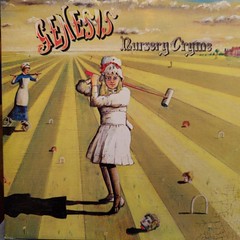
In my humble opinion, Nursery Cryme is the first truly great Genesis record from the classic period. It arrived with a new lineup, which now included Steve Hackett and Phil Collins, who joined the remaining members, Peter Gabriel, Tony Banks, and Mike Rutherford. This lineup produced some of my favourite Genesis records.
The album opens with The Musical Box, a 10+ minute epic that heralded the new Genesis sound and vision. The record announced that the band had finally found its sound. Of course, there were naysayers, those that didn't understand what the band was doing. But, Wikipedia notes--as is so often the case--that reviews in hindsight have been more positive, proof that reviewers often have no idea what they are talking about and sometimes fail to see and comprehend new musical ideas.
In a foreshadowing, of sorts, Phil Collins sings lead vocals on For Absent Friends.
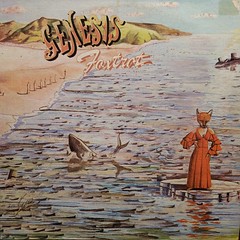
Peter Gabriel, Tony Banks, Michael Rutherford, and Anthony Phillips, all return (with the addition of John Mayhew on drums) for record number two, which is really the band's first foray into progressive (prog) rock. I think it's fair to say that this is the band's first proper record. You might say that it's the first Genesis record as a real band. It's clearly a definite change in direction. Anthony Phillips left after this record.
There are lots of prog haters out there. I like a small number of prog bands, but I wouldn't say that I am "into" prog music by any means. Some prog sounds OK to me and some of it sounds ponderous. Rather than attempting to define the genre myself, I will turn to Wikipedia:
"Progressive rock sometimes abandons the danceable beat that defines earlier rock styles and is more likely to experiment with compositional structure, instrumentation, harmony, rhythm, and lyrical content. It may demand more effort on the part of the listener than other types of music. Musicians in progressive rock typically display a high degree of instrumental skill. Musical forms are blurred through the use of extended sections and of musical interludes that bridge separate sections, which results in classical-style suites. Early progressive rock groups expanded the timbral palette of the then-traditional rock instrumentation by adding instruments more typical of folk, jazz, or music in the classical tradition. A number of bands, especially at the genre's onset, recorded albums in which they performed with full orchestras. Progressive rock artists are more likely to explore complex time signatures such as 5/8 and 7/8. Tempo, key, and time signature changes are common within progressive rock compositions."
[source]
Notable prog rock acts include Genesis, Pink Floyd, Yes, King Crimson, Marillion, though I'm really not sure that Pink Floyd belongs in this list. I always viewed Floyd as more psychedelic.
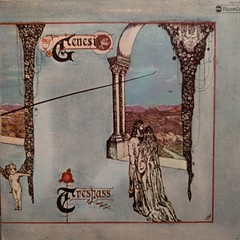
In any case, Trespass shows where Genesis was going, and that may be the only reason to listen to it. As a fan, though, I like this album, but not as much as what came later. The best song, for me, is The Knife.
This record has been released so many times and on so many labels, it's hard to keep track. The first release on Decca in 1969 is a valuable record. But, there are dozens of releases on vinyl that are easily found and far cheaper. So, take your pick.
The lineup for this version of Genesis was Peter Gabriel, Tony Banks, Mike Rutherford, and Anthony Phillips, with Chris Stewart joining later on drums. He was later replaced by John Silver, who was later replaced by John Mayhew. Note, that Phil Collins and Steve Hackett joined the band later.
The liner notes describe how the band could not be called Genesis because there was an American band with that name. If you read the Wikipedia entry, there are lots of details about the record, like who owns the rights, etc. This album was not included in the 1970-1975 box set. That's curious, but probably has a lot to say about how the band felt about the record. It was not a commercial success by any means and it is not representative of the Genesis sound we know.
It's worth noting that the songs are not the prog pieces that Genesis became known for in the 1970s. These tracks are more straight forward, albeit tracks with some pretensions. I think all of the members were still in their teens, so this was really probably more of a learning experience for them.
I didn't own a copy of this record on vinyl until recently, when I saw the limited edition (1500 copies) 180 gram version from 2014 at a huge discount, so I think I paid about $10.
I would say that unless you are a rabid Genesis fan, there is no need to own this record. The band hit its stride a little later on. Still, it is interesting to hear what they were doing in the very late 60s.
Sorry for the terrible photo. I didn't want to remove the shrink wrap, so the reflection from the overhead light is a killer.
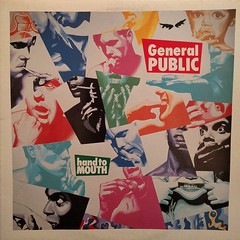
Allmusic's review of the record is so unbelievably mean-spirited. The critic writes:
"Continuing All the Rage's trend towards slick pop production, but finally tipping over into bland
anonymity, the album makes absolutely no musical impression even after several listens. Even worse, the songs are a uniformly dire lot, replacing the reggae and Brit-pop influences with newfound interests in American R&B and chart pop. Even the few moderately catchy songs are
flawed; the gospel-influenced single "Come Again" moves along cheerfully enough until an absurdly over-emphasized "boop boop!" shout in the chorus makes the whole thing sound simply ridiculous."[source]
I agree that the record is mediocre, but it doesn't live up to that terrible review.
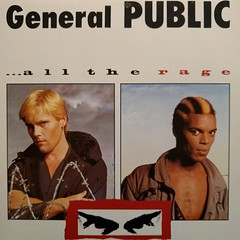
After the dissolution of The Beat (AKA, the English Beat or the British Beat), Dave Wakeling and Ranking Roger formed the more pop-oriented General Public with an ex-Specials member, plus a former member of Dexy's Midnight Runners. Oddly, Mick Jones, formerly of The Clash, appears on many tracks, but departed to create Big Audio Dynamite. The liner notes say: "Mick Jones on loan from Real Westway and appears courtesy of CBS Records." Imagine being able to loan or borrow people. I have a long list of people I would love to borrow.
The band is OK, but not quite as good as The Beat. Still, they managed to produce a big hit with Tenderness. Roger's hairstyle didn't really catch on.
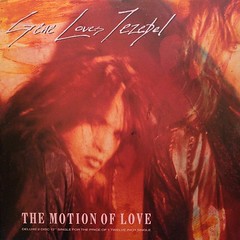
The Motion Of Love was probably the most recognizable track from The House of Dolls. The band had shifted clearly from goth (whatever that really means) to some sort of more straight ahead rock sound. The Motion Of Love is a pretty good track.
This "deluxe 2 disc 12" single for the price of 1 twelve inch single" has these track:
The Motion Of Love (Jezebel Mix)
A Fresh Slice
Bugg's Bruises
Vagabond (A New Adventure)
Some comments of youtube give me pause. Regarding this tune, someone actually wrote: "Best song ever." That person has clearly missed a lot. I could name hundreds of songs that are better.
I saw Gene Loves Jezebel in concert ages ago. They opened for Echo and the Bunnymen or maybe the Cure or maybe it was New Order. I cannot remember which it was. I remember very little about their set.
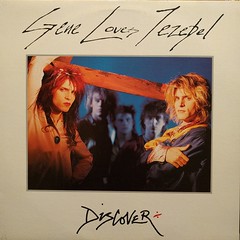
If you were to describe this band, you would have to use the term goth, though I often feel that the term goth has more to do with the look of the band rather than the sound. I am not sure how helpful it is. Discover is probably the band's most notable record, because of the track Desire (Come and Get It).
After reading the review on Allmusic, I am tempted to put this record on the turntable, maybe just to see if I missed something. They write:
"This was GLJ at it's best, as the band came together in a perfect wedding of all parties, sounds, and styles. Stadium guitar, Bauhausian experimentation, pop, and goth all combined to make a truly unforgettable album." [source]
It seems overwritten to me, or maybe I wasn't paying enough attention to the band.
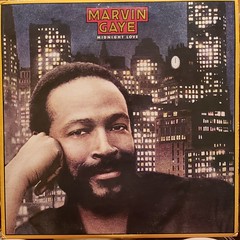
The record was, sadly, his last, before he was murdered. This record contains Sexual Healing, one of Marvin's biggest hits. My copy is slightly warped, though it plays fine.
This is an incredible record, which enjoyed tons of immediate critical accolades. I have a 180g reissue, likely pressed 1997 or 1999. You must know the title track and Mercy Mercy. In the early days, I thought that What's Going On was a question, but it's not.
This Art Garfunkel record contains a mini Simon and Garfunkel reunion, in the track called My Little Town, which was written by Paul Simon. This track also appears on Paul Simon's Still Crazy After All These Years.
Again, none of these songs sere composed by Garfunkel. I think I should add this to the pile of records I might purge. Records take up a lot of space, and I need to make sure I have space for the ones I really want. It's likely I will dump this one.
"If Simon & Garfunkel had been the thinking man's Everly Brothers, Garfunkel alone turned out to be the thinking man's Johnny Mathis." [source]
I can't pretend that I understand what this means, but it sounds good.
Garfunkel, otherwise known as Art Garfunkel was, of course, the other half of Simon and Garfunkel. Garfunkel's strength has always been as a vocalist, not as a songwriter. On this--his debut--he wrote no songs, which is odd, because the man is also a poet, or so I have read. So, for this record, he compiled a bunch of tracks and sang them. In truth, the songs are not too bad.
If you do a Google search for Art Garfunkel, one of the suggested
searches is: art garfunkel death. As far as I know, he is still alive.
This is another of those curious farewell tours that didn't really take. IN 1984, Gang of Four called it quits, and this recording, from Hollywood, was to stand as a memorial of thee goodby. Like the Who, they got back to business, though we had to wait seven years for a new record.
The critics hated this record,and I understand why. I think it's just OK, especially if I forget that it's the Gang of Four ... I mean the Gang of 4. At least Discogs didn't create a new entry for the band, since the record spells out the band as Gang of 4. Instead, it just gets an asterisk. Is that progress?
The original drummer left prior to this recording. Of course, Dave Allen
departed prior to the previous record and ended up forming Shriekback.
I rarely listen to this one. A Man with a God Car might be the highlight of the record.
It's strange that this EP was only released in the USA and Canada. What's up with that? Maybe that's why it called a "Special Edition 12" E.P." There are five tracks, wit the lead off track being the nost interesting, at least to my ears. Side B was ecorded live at the Hammersmith Palais on March 30, 1981.
To Hell With Poverty
Capital (It Fails Us Now)
History's Bunk!
Cheeseburger
What We All Want
Here is a live version of To Hell With Poverty from British TV in 1981. Awesome, right? I suppose it'a worth mentioning that Dave Allen, on bass and guitar, later went on to join Shriekback and, later, King Swamp.
"Drummer Hugo Burnham and bassist Dave Allen generated a minimalist yet monstrous groove that underpinned Andy Gill's jagged, funky, slash-and-kill guitar and the flat, plainly didactic vocals of Jon King, and the resulting sound was bracingly unique. This debut EP was the sparest, most frightening thing the band ever released." [source]
I can agree with the above statement.
The original price for this EP (in US dollars) was $4.98. It's printed on the spine. That was probably a little too expensive in 1980, but I could be wrong. Anyway, this self-titled EP (also known as the Yellow EP) has four tracks, and man, there are good.
I suppose that the name of this band wouldn't fly today. Social media would be all over them, like Viet Cong, and they would be forced to change the name.